Ocean Policy
World Ocean Day 2026: From Dependence to Stewardship
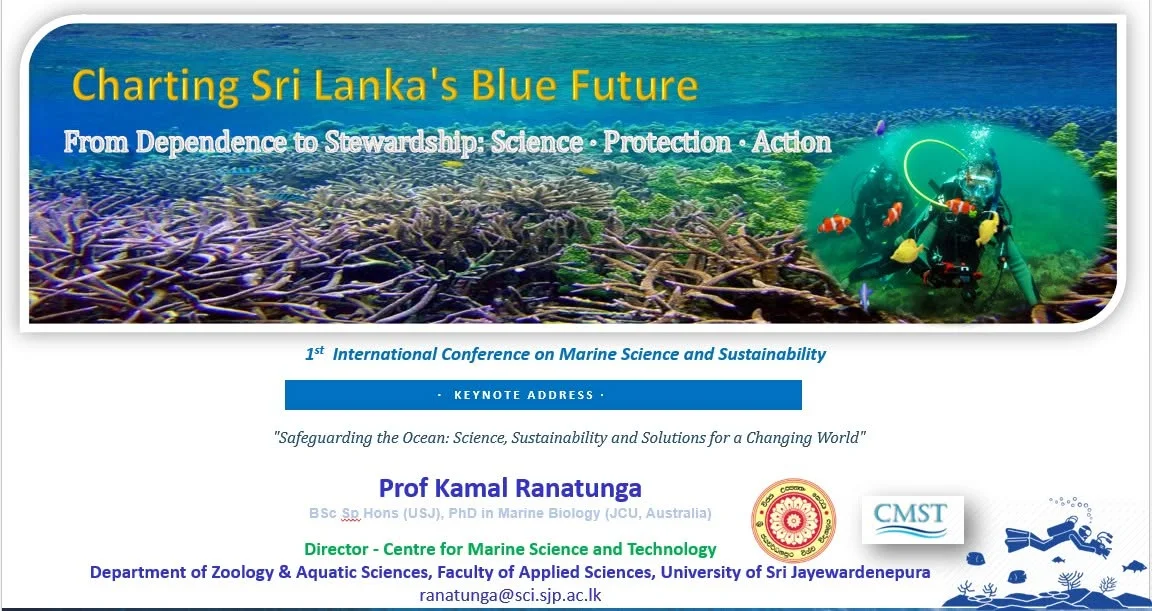
Honored to have delivered the keynote address, "From Dependence to Stewardship: Charting Sri Lanka's Blue Future Through Science, Protection, and Action", at the 1st International Conference on Marine Science and Sustainability, organized by the Open University of Sri Lanka in partnership with the Marine Environment Protection Authority (MEPA), in commemoration of World Ocean Day 2026.
The talk centered on pressing ocean crises that Sri Lanka, and much of the Indian Ocean region, can no longer defer: fisheries decline, coral reef degradation, recurring maritime disasters, plastic and other pollution, direct sewage discharge to sea, the erosion of coastal tourism appeal, and most critically, the fragmentation of ocean governance with no central coordinating authority.
Key messages I left with the audience:
🐠 Sri Lanka's marine fish catch has declined sharply over recent years, yet we remain dependent on a high-fuel, high-effort capture fishery. We are an island nation that still imports fish.
🪸 The majority of Sri Lanka's coral reefs are already dead or severely degraded. The most recent global bleaching event has struck reefs worldwide, compounded by multifactorial stressors, including warming, acidification, and sedimentation.
🚢 Maritime disasters in the Indian Ocean are now an increasing pattern. We do not yet have a Marine Emergency Response Authority, despite being adjacent to one of the world's busiest shipping corridors, with 300+ vessels passing daily.
🌐 Sri Lanka protects only (<0.3%), a fraction of its Exclusive Economic Zone, a figure unchanged for many years, against a global average now approaching 10% and a 30×30 target of 30% by 2030.
⚖️ The keystone reform: a national ocean governance statutory authority, one binding plan and the political will to begin immediately.
The science is clear. The solutions are implementable. What the ocean asks of us now is practical action: marine spatial planning, a network of marine protected areas, enhanced ocean literacy from school age upward, and above all, political courage.
Deep gratitude to the Open University of Sri Lanka and MEPA for creating this platform and to the conference organizers, fellow scientists, and students who filled the room with the energy this conversation deserves.
The ocean does not wait. Neither should we.
Gallery
Related news
- Research
When Big Data Gets a Small Country Wrong
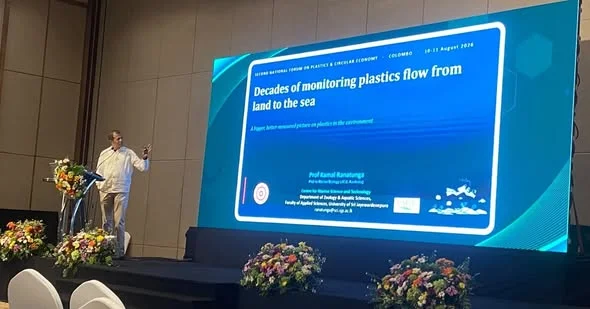
A widely cited global study ranked Sri Lanka among the world's worst contributors to ocean plastic pollution. New field-based research from CMST and collaborators at CSIRO Australia challenges the assumptions behind that ranking and makes the case for policy built on local scientific evidence.
Read Full Article - Conservation
In Search of the Asoka Pethiya
Following recent floods, researchers returned to the upper Sitawaka and Kelani river systems in search of the critically endangered Asoka barb. Their observations highlight growing threats to one of Sri Lanka's most range-restricted freshwater fishes.
Read Full Article - Research
Tracing the Plastic Tide
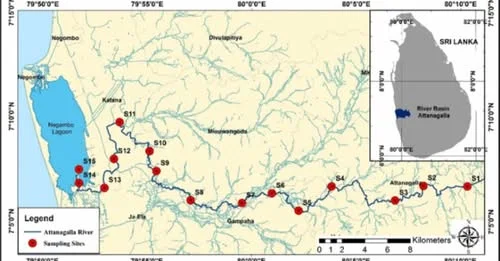
A new CMST study traced microplastics across 15 sites along the Attanagalu River, from its headwaters to the river mouth, revealing how plastic pollution moves downstream toward Sri Lanka's coastal seas.
Read Full Article